
Browse products by
Filter By Type
Filter By Finish
Filter By Look
Filter By Application


Filter By Type
Filter By Look
Filter By Application
Filter By Size
Blog
Moroccan Tiles: History, Design Styles & How to Use Them in Indian Homes
May 2026

There are tiles that cover a surface. And then there are tiles that tell a story.
Moroccan tiles belong firmly in the second category. Their intricate geometric patterns, vivid colour combinations, and centuries of craft history make them unlike anything else in the world of flooring and wall design. They transform ordinary rooms into extraordinary spaces and they do it with a confidence and cultural richness that no plain or minimalist tile can match.
In India, Moroccan-style tiles have found a natural home. Our design culture has always celebrated pattern, colour, and craftsmanship values that Moroccan tile design shares completely. Whether you’re renovating a heritage haveli in Rajasthan, designing a contemporary apartment in Mumbai, or fitting out a boutique hotel in Goa, Moroccan tiles bring a layer of warmth, personality, and visual depth that makes any space genuinely memorable.
This guide covers the history behind Moroccan tiles, the main design styles available today, the most popular formats including the much-searched Moroccan tiles 2×2, and a practical room-by-room guide for using Moroccan floor tiles and wall tiles in Indian homes.
The History of Moroccan Tiles
Moroccan tile design has its roots in the Islamic geometric art tradition, which emerged across the Middle East and North Africa from the eighth century onwards. Islamic architectural tradition placed geometric pattern at the centre of decorative art — partly for aesthetic reasons, partly for philosophical ones. The intricate, infinitely repeating patterns of Islamic geometric design were understood as a visual expression of the infinite nature of creation itself.
In Morocco specifically, this tradition evolved into the art of zellige hand-cut ceramic tiles assembled into complex geometric mosaics. Zellige tiles are made from fired ceramic coated in an opaque coloured glaze, cut by hand into geometric shapes, and assembled face-down into patterns before being set into a plaster or cement base. The technique requires years of apprenticeship to master, and the finest zellige work — in the mosques, palaces, and riads of Fez, Marrakech, and Meknes is among the most breathtaking decorative art produced anywhere in the world.
By the medieval period, Moroccan tilework had spread through the influence of trade, travel, and the movement of craftspeople across the Islamic world. Spanish and Portuguese azulejo tiles, Italian majolica, and the decorative tile traditions of Turkey and Iran all share common roots with Moroccan zellige. When Portuguese traders carried these tiles to Goa in the sixteenth century, they planted seeds that would eventually grow into India’s own decorative tile traditions.
Today, Moroccan-style tiles are manufactured worldwide including by leading producers in Morbi, Gujarat using modern ceramic and porcelain technology to replicate the patterns and colour palettes of traditional zellige at a fraction of the cost and in formats that suit contemporary installation methods.
Moroccan Tile Design Styles
Not all Moroccan tiles look the same. The tradition encompasses several distinct design families, each with its own character and best applications.
Zellige-Inspired Geometric Tiles
The most authentic Moroccan tile aesthetic. Complex eight-pointed stars, interlocking hexagons, diamonds, and crosses arranged in repeating patterns typically in two to four contrasting colours. Traditional colour combinations include deep cobalt blue with white, terracotta with cream, forest green with black, and turquoise with sand. These tiles make the strongest visual statement and work best as feature floors, bathroom walls, and kitchen backslash.
Encaustic-Pattern Moroccan Tiles
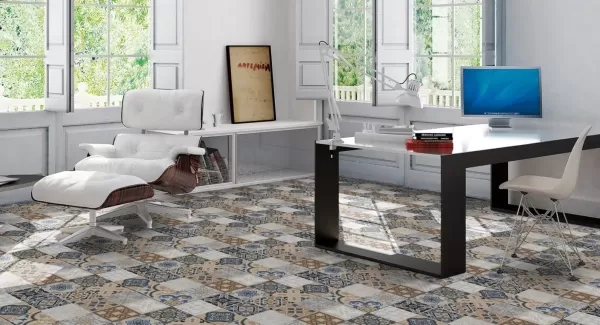
Encaustic-style Moroccan tiles use a simpler, bolder geometric vocabulary large diamonds, quatrefoils, arabesque curves, and cross-star combinations in a format that is easier to read and less visually intense than full zellige. These are the most popular Moroccan floor tiles for Indian homes because they balance pattern and practicality beautifully. Available in both traditional polychrome palettes and modern two-tone combinations.
Moroccan Cement Tiles
Traditional Moroccan cement tiles have a soft, matte surface and a handmade quality that porcelain and ceramic tiles replicate with varying degrees of accuracy. Their slightly irregular, artisanal surface catches light differently from every angle creating a floor or wall that is never static, always alive. Popular in bohemian, eclectic, and heritage-style interiors.
Moroccan Wall Tiles with Relief Surface
A newer interpretation of the Moroccan tradition ceramic wall tiles with a three-dimensional relief surface that creates texture and shadow rather than colour contrast. Available in white, off-white, and soft grey, these tiles bring Moroccan geometry to contemporary interiors without introducing colour a sophisticated approach for spaces that want cultural reference without pattern maximalism.
Modern Moroccan-Style Tiles
Contemporary tile manufacturers including Lavish Ceramics produce Moroccan-inspired tiles that take traditional geometric patterns and reinterpret them in modern palettes dusty blush, sage green, warm terracotta, muted teal, and soft charcoal making the Moroccan aesthetic accessible to a much wider range of interior styles than the traditional vivid polychrome palette.
Moroccan Tiles 2×2: The Most Popular Format for Indian Homes
The Moroccan tiles 2×2 format 600×600mm in metric terms is by far the most commonly specified Moroccan tile for residential flooring in India. Here’s why this format works so well:
Scale: A 600×600mm tile is large enough for the pattern to be fully appreciated across a floor, but small enough to be manageable in typical Indian room sizes, whether an apartment bathroom, a puja room, or a compact kitchen.
Versatility: The 2×2 format works equally well on floors and walls, giving you the flexibility to use the same tile throughout a space for continuity, or mix floor and wall formats for contrast.
Installation efficiency: Standard 600×600mm tiles align with the working methods and tooling of most Indian tile installers reducing installation complexity and labour cost compared to irregular or large-format Moroccan tiles.
Pattern completion: Most Moroccan tile patterns are designed to complete their geometric repeat within a 600×600mm tile — meaning the full design is visible in a single tile, and the pattern locks together perfectly across the floor without requiring complex cutting at edges.
At Lavish Ceramics, our Moroccan-style tiles in the 2×2 format are available in both traditional polychrome palettes and contemporary reinterpretations suitable for floors and walls in residential and light commercial applications.
How to Use Moroccan Tiles in Indian Homes: Room by Room?
Kitchen Splashback
The kitchen splashback is the single most popular application for Moroccan tiles in Indian homes and one of the easiest wins in any renovation. A run of Moroccan tiles from worktop to cabinet base brings colour, pattern, and personality to a kitchen that plain subway tiles or solid colours simply cannot match.
Keep the cabinet colour simple white, cream, grey, or natural timber and let the Moroccan splashback lead. A traditional cobalt blue and white geometric pattern against white shaker cabinets is a combination that has looked good for centuries and will continue to do so.
Bathroom Floor
Moroccan floor tiles in a bathroom create an immediate sense of luxury and intention. The geometric patterns work particularly well in bathroom settings because the smaller scale of the space means the pattern can be fully appreciated without being overwhelming.
For bathroom floors, choose a Moroccan floor tile with a matte or textured finish for adequate slip resistance. Traditional encaustic-pattern tiles in terracotta, cobalt, or soft green tones against white walls and chrome fixtures is a combination that suits both contemporary apartments and heritage-style homes.
Pooja Room
The pooja room is where Moroccan tiles find perhaps their most natural Indian application. The intricate geometric patterns of Moroccan tile design share a deep kinship with the mandala and yantra traditions of Indian sacred geometry. A Moroccan-tiled floor in the pooja room particularly in saffron, deep red, gold, or cobalt combinations creates a space that feels genuinely sacred and considered.
Entrance Hall and Foyer
The entrance hall sets the tone for the entire home. A Moroccan tile floor in the foyer even a small one creates an immediate impression of design confidence and cultural awareness. It tells visitors something about the home before they’ve seen a single piece of furniture. Use a bolder, more complex pattern here where it will be seen and appreciated as you arrive and leave.
Outdoor Courtyard and Verandah
Moroccan tiles have a long tradition of outdoor use in the open courtyards and garden spaces of North African riads, they create floors of extraordinary beauty. In Indian homes, an outdoor verandah or internal courtyard tiled in Moroccan patterns connects beautifully to the haveli and bungalow traditions of Indian architecture. Choose an outdoor-rated porcelain Moroccan tile with appropriate slip resistance and UV stability for exterior applications.
Accent Wall in Living Room or Bedroom
A single wall of Moroccan-pattern tiles behind the sofa, as a headboard feature, or framing a fireplace is one of the most design-forward moves available in contemporary Indian interiors. It adds cultural depth and visual richness without the commitment of tiling an entire room. Use a restrained, two-tone Moroccan pattern for maximum versatility.
Moroccan Tiles and the Indian Design Tradition
The appeal of Moroccan tiles in Indian homes is not simply about following a global trend. There is a genuine cultural resonance between Moroccan decorative traditions and Indian design sensibilities that goes far deeper than aesthetics.
Both traditions celebrate geometry as an art form. Both use colour boldly and without apology. Both understand that a beautiful surface whether on a floor, a wall, or an archway is not decoration in the superficial sense but a form of meaning-making that elevates everyday life.
When you choose Moroccan tiles for an Indian home, you’re not importing a foreign aesthetic you’re connecting to a shared visual vocabulary that spans continents and centuries.
Moroccan Tiles Catalogue: Browse the Lavish Ceramics Collection
At Lavish Ceramics — Lavish Granito Pvt. Ltd., Morbi, Gujarat, we design and manufacture Moroccan-style tiles for residential and commercial customers across India and more than 50 countries worldwide. Our Moroccan tile range includes:
- Classic zellige-inspired geometric patterns in traditional polychrome palettes
- Contemporary Moroccan-style tiles in modern, muted tones
- Moroccan tiles 2×2 (600×600mm) for floor and wall applications
- Encaustic-pattern Moroccan floor tiles in matte and textured finishes
- Relief-surface Moroccan wall tiles for contemporary interiors
Download our Moroccan tiles catalogue for the full range with product codes, sizes, colour options, and technical specifications. Samples are available on request see and feel the tile before you commit.
- Trade and export enquiries welcome, we support architects, interior designers, contractors, hospitality developers, and international distributors
- Visit lavishceramics.com to explore the full Moroccan tile collection
A great tile does more than cover a surface. It carries history, culture, and craft into your home. That is what Moroccan tiles have always done and what they will continue to do for centuries to come.
Similar Articles

Leave a Reply