
Browse products by
Filter By Type
Filter By Finish
Filter By Look
Filter By Application


Filter By Type
Filter By Look
Filter By Application
Filter By Size
Blog
Modern Floor Tiles Design Trends for 2026
Mar 2026

Flooring used to be a late decision. Walls first, furniture next, tiles at the end. That sequence doesn’t quite hold anymore.
In current projects, the floor is often decided early, sometimes even before the wall finishes. Not because it is more important, but because it affects everything else.
Light behaves differently on it. Furniture reads differently against it. Even the scale of a room can shift depending on what goes underfoot.
That’s where modern floor tile design is heading. Let’s check out some of the latest floor tile designs!
Large Format Glazed Porcelain Tiles
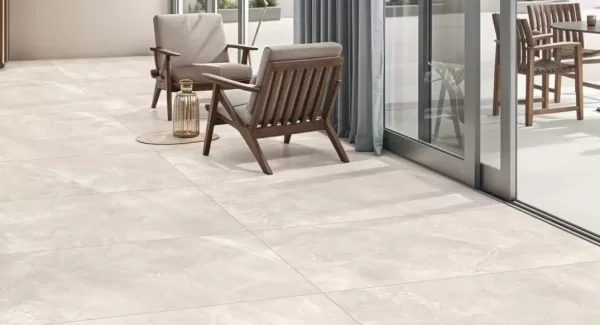
Large formats are everywhere right now, and not just in high-end spaces. Glazed Porcelain Tiles in sizes like 600×1200 mm or larger are becoming fairly standard.
The logic is simple. Fewer grout lines mean fewer visual breaks. So, when those interruptions are reduced, the floor looks like a single continuous surface rather than a patchwork.
In smaller rooms, this can make a noticeable difference. The space feels less crowded. In larger layouts, it helps maintain consistency across long spans.
Another thing that’s changed is usage. The same tile is often extended onto walls. Now, it is less about matching and more about continuing the same material across surfaces. This also reduces the need to coordinate multiple finishes within the same space, which can otherwise complicate design decisions.
This is a key reason why large-format floor tile design is becoming the default choice in modern layouts.
GVT & PGVT Tiles
A lot of decisions now come down to finish rather than just design. This is where GVT and PGVT Tiles come in.
GVT tiles usually work better where a softer, non-reflective surface is needed. Living rooms, bedrooms, and spaces where too much shine can feel distracting. PGVT tiles, being polished, are used when a sharper, more reflective finish is preferred.
Thus, what has improved over time is consistency. The printing is more controlled now. You don’t get abrupt variations between tiles, which used to be a common issue earlier.
Moreover, they’re often chosen not because they stand out, but because they don’t create problems later. That matters more in large installations.
Another practical advantage is availability across multiple finishes within the same design family, which allows flexibility without changing the overall look. This makes them a reliable option within the latest floor tile design selections.
Matt & Structured Finish Tiles
Glossy floors are still around, but they’re no longer the default.
Matt-finish tiles are easier to live with. They don’t reflect harsh light, they don’t show smudges as easily, and they generally work across different lighting conditions.
Then there are Structured Finish Tiles, which add a slight texture. Not enough to make cleaning difficult, but enough to improve grip. That becomes useful in kitchens, bathrooms, or even semi-outdoor areas.
A lot of current contemporary floor tiles fall into these categories because they balance appearance with practicality. They have nothing excessive, just surfaces that behave well over time.
They also tend to age better visually, as minor wear or marks are less noticeable compared to highly polished surfaces. Hence, we can say this is where stylish floor tiles are now leaning, toward usability rather than shine.
Outdoor & Parking Tiles
One shift that’s quite noticeable is how indoor and outdoor flooring are being aligned.
Instead of treating them as separate decisions, similar designs are now used in both areas. The difference lies in the specifications.
Outdoor Tiles and Parking Tiles are built to handle moisture, temperature changes, and heavier loads. They also have better slip resistance.
Visually, though, they’re often kept close to indoor tiles. That way, when a living room opens into a balcony or terrace, the transition doesn’t feel abrupt.
It also simplifies material selection, since designers can work with a unified palette instead of managing completely different surfaces. This approach is becoming central to the latest floor tile design thinking.
In practical terms, this reduces installation complexity as well. Using related materials across spaces helps maintain consistency in thickness, alignment, and joint planning.
Decorative & Patterned Tiles
Patterns haven’t disappeared, they’re just being used more carefully.
Decorative Tiles and Patterned Tiles are usually limited to specific areas now. Entry points, small sections within larger layouts, sometimes as inserts.
Terrazzo-style designs, linear patterns, and even checkerboard layouts still show up. The difference is they’re not covering entire floors like before.
This keeps things balanced. You get variation without making the space feel busy.
In many cases, these tiles are used to define zones within open layouts, without the need for physical partitions. That’s how modern tile patterns are being applied now, more controlled, less dominant.
Double Charge & Full Body Tiles
Some areas simply demand tougher materials. That hasn’t changed.
Double chrage tiles have a thicker top layer, which helps with wear resistance. Full Body Tiles go a step further; the design runs through the entire tile, so even if there’s damage, it’s less visible.
These are commonly used in commercial spaces, but also in parts of homes that see constant use.
What’s changed is that they no longer look overly industrial. The finish is more refined now, so they can fit into modern layouts without standing out for the wrong reasons.
They are also preferred in projects where long-term maintenance needs to be minimized, making them a strong part of luxury floor tile design, where durability is equally important.
Wrapping Up
If there’s one clear direction in the latest floor tiles design, it’s this: decisions are becoming more practical, but not in a boring way.
Materials are expected to last, to be easy to maintain, and to work across different conditions. At the same time, they need to fit into a clean, modern visual framework.
Lavish Ceramics approaches this through categories that are straightforward: Glazed Porcelain, GVT and PGVT, Full Body, and Outdoor. Each serves a purpose. The choice depends less on trend and more on where and how the tile will be used.
There is also a growing preference for materials that can remain relevant over time, rather than following short-lived design cycles. This makes selection slightly more deliberate, with greater attention to finish, format, and long-term usability.
That shift, more than anything else, is what defines flooring in 2026.
Similar Articles

Leave a Reply