
Browse products by
Filter By Type
Filter By Finish
Filter By Look
Filter By Application


Filter By Type
Filter By Look
Filter By Application
Filter By Size
Blog
10 White Marble Floor Tiles Designs for Modern & Luxury Homes
Apr 2026

White marble floor tiles aren’t new, but the way they’re being used has shifted. They’re no longer treated as the focal point. Instead, they’re expected to support the overall space and quietly tie things together.
With newer vitrified and porcelain options from Lavish Ceramics, getting that marble look is also far more practical now. You don’t have to deal with the same level of staining or maintenance that natural marble usually demands.
What really changes the outcome, though, is how the tile is laid.
The same design can feel either clean and expansive or slightly off, depending on the layout, what it’s paired with, and how natural light moves across it during the day. That’s where most spaces either come together or fall short.
If you’re trying to avoid that almost-there result, the ideas below focus on what actually works in real settings.
1. Seamless Slab Flooring for Open Layouts
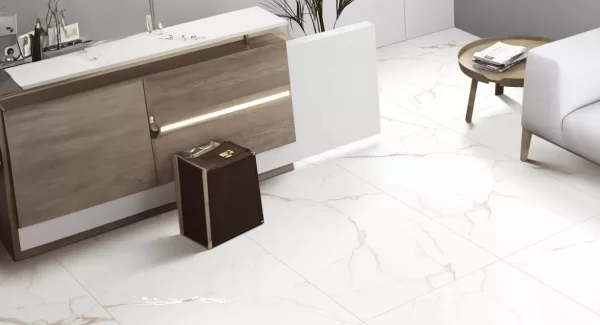
Large-format white marble floor tile (like 1200×1800 mm) tend to read less like individual units and more like a continuous surface.
This restraint is what aligns it with modern luxury interiors, where continuity often matters more than surface variation.
For living rooms in particular, this approach with the best white marble tiles for living room holds up well over time, both visually and practically.
2. Warm White Marble with Gold Veining
Plain white can sometimes come off a bit harsh, especially under cool lighting. Tiles with soft gold or beige veins take that edge off.
These white marble tiles for home floor setups sit well with wood, warmer lights, and even muted metallic accents. The result feels more relaxed without losing that clean look.
It’s a small shift, but it changes how the whole room feels.
3. Book-Matched Feature Zones
You don’t need to book-match the entire floor. In fact, doing that can feel overdone.
A better approach is to use it in one spot, maybe under a seating arrangement or right in the center of a hall. The mirrored veins draw attention, but because it’s limited, it doesn’t take over everything.
It’s an easy upgrade for white floor tiles for hall designs without adding anything extra.
4. Mixing Gloss and Matte Finishes
Using only one finish across the floor can feel a bit flat after a while.
Try combining white glossy tiles for floor in the main area with a matte version of the same tile nearby. You’re not changing the color or pattern, just the way light reacts to it.
It’s subtle, and the floor feels more layered.
5. Let the Veins Guide the Layout
Some tiles have long, directional veins, and how you place them actually changes how the room feels.
If you lay them along the longer side of a room, it can make the space look more stretched. This works especially well in corridors or tighter layouts.
Using simple white marble tiles here keeps things clean while still doing something useful with the layout.
6. Marble “Rug” Without a Rug
Instead of placing an actual rug, you can create a defined zone using tiles themselves. A white marble base with a darker border works surprisingly well.
This is practical in areas where rugs are hard to maintain, like dining spaces.
It’s a smart use of marble design tiles for home without introducing extra materials.
7. Soft Carrara for Everyday Spaces
Not everyone wants bold veins running across the floor. Carrara-style tiles with light grey patterns are an excellent substitute for them.
These simple white marble tiles don’t compete with furniture or decor. They just sit in the background and do their job.
If your space already has a lot going on, this kind of flooring keeps things from feeling crowded.
8. Breaking the Straight Line with Wood
That sharp line between marble and wood flooring can feel a bit abrupt. A more natural way is to let the two materials meet in a staggered or interlocking pattern.
It softens the transition and makes open spaces feel more connected.
This works well in white marble tiles for home floor layouts where the kitchen flows into the living area.
9. Bold Statuario for a Stronger Look
If you actually want the floor to stand out, Statuario-style tiles with heavy veining can do that.
But here’s the catch. Everything else in the room needs to stay simple. Otherwise, it starts to feel chaotic.
These are often picked as the best white marble tiles for living room when the goal is to give the space a sharper identity.
10. Simple Border Framing
A thin dark border around white tiles can change how the entire floor is perceived. It adds structure without making things heavy.
This is especially useful in entryways or larger halls.
Here, white floor tiles for hall help organize the space without complicating it.
What Actually Makes a Difference
Finish
Glossy tiles bounce light around, making rooms feel brighter. Matte finishes feel softer and offer better grip. It really depends on where you’re using them.
Tile size
Large tiles make the floor feel continuous. Smaller ones add more joints, which can either add detail or make things look busy.
Grout
People often ignore this, but grout color matters. Matching it to the tile usually yields cleaner results for white marble floor tiles.
Maintenance
Vitrified tiles are easier to manage than natural marble. You don’t have to worry as much about stains or special care.
Lighting
The same tile can look different under warm and cool lighting. It’s worth checking samples in your actual space before finalizing.
Mixing materials
Pairing marble with wood, fabrics, or metal keeps the space from feeling too plain or overly polished.
Wrapping Up
White marble floor tiles work best when they’re treated as a base rather than a showpiece. The layout, the finish, and what they’re paired with shape the outcome as much as the tile itself.
With well-made vitrified and porcelain options from Lavish Ceramics, it’s easier to get that balance right. The marble look stays consistent, while maintenance and durability are easier to manage over time.
Get these decisions right, and the space feels composed and easy to live in. Miss them, and even a premium tile won’t hold the room together.
Similar Articles

Leave a Reply