
Browse products by
Filter By Type
Filter By Finish
Filter By Look
Filter By Application


Filter By Type
Filter By Look
Filter By Application
Filter By Size
Blog
Why Porcelain Tiles for Living Room Are the Perfect Choice for Modern Homes
Mar 2026

Flooring decisions in a living room are often approached as visual choices. In practice, they tend to function more as material decisions, shaping how a space responds to use rather than how it appears at the outset.
Most surfaces perform well and good in the beginning. The distinction only becomes visible over time, when everyday use starts to test them in small, repetitive ways.
It is within this longer frame that porcelain tiles for living room applications begin to make sense. This shift might not first come as a stylistic preference, but as a material choice that aligns with how living rooms are actually used today.
Let’s see how.
1. Durability Is The Edge
Among durable living room tiles, porcelain is often reduced to a single idea. Hardness. Accurate, but not quite informative.
What matters more is uniformity.
The material is vitrified throughout, so the surface and the interior behave almost identically. In many other flooring types, wear tends to expose a softer layer beneath. Porcelain does not generally operate that way.
Over time, this changes how ageing is perceived. Not eliminated, just less visible.
Furniture shifts slightly. Fine abrasions occur. Foot traffic builds in patterns you do not immediately notice. All of it still happens. But instead of concentrating on obvious patches, the effect spreads out.
Quality plays a role here. Well-produced tiles, such as those seen in curated ranges like Lavish Ceramics, tend to maintain consistency in density and finish. That consistency, while subtle, affects how evenly the surface wears over time.
The result is a floor that remains visually steady, rather than gradually uneven.
2. Low Maintenance Is The Material Outcome
The practicality of any porcelain floor tile design is closely tied to how little it absorbs.
With porosity typically below 0.5 percent, liquids do not really enter the material. They stay on the surface, where they are easier to deal with.
Which, in everyday terms, simplifies things:
- Spills rarely become permanent marks unless ignored.
- Cleaning remains straightforward.
- There is no ongoing cycle of sealing or refinishing.
What tends to go unnoticed is not just the ease, but the consistency of it. The floor behaves much the same way years later as it did at the beginning.
That reliability is often more apparent in well-finished products. Collections like Lavish Ceramics, for instance, place emphasis on surface uniformity, something that reveals itself gradually rather than immediately.
3. Design Versatility
The conversation around modern living room tiles in porcelain often stops at imitation, marble, wood, and concrete.
A more useful way to think about it is control.
Natural materials derive their appeal from variation, but that variation is not always predictable. Sometimes it enhances the space, sometimes it complicates it. Porcelain sits somewhere in between.
It reproduces variation, but selectively.
This becomes particularly evident in luxury porcelain tiles, where surface patterns appear intentional rather than incidental.
Design-led collections, such as those from Lavish, tend to strike this balance carefully. Enough variation to avoid monotony, but not so much that it feels inconsistent across the floor.
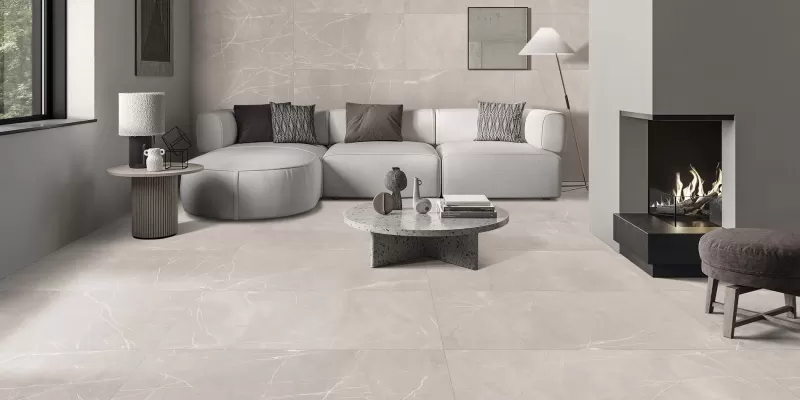
With large porcelain tiles for living room layouts, the effect shifts further. It happens because fewer grout lines mean fewer interruptions.
The floor begins to read less like a pattern and more like a surface.
Subtle, but perceptible.
4. Indoor Stability, A Plus That Comes With Surface Cleanliness
Porcelain’s role in indoor environments is rarely emphasised, yet it offers a significant advantage.
Because it does not absorb much, it does not retain much either.
Dust, allergens, and moisture remain external rather than becoming embedded. This makes them easier to remove and less likely to accumulate without notice.
This does not dramatically change how the living room looks. But it does influence how it feels to maintain.
There is a certain steadiness to it in knowing nothing is quietly building up beneath the surface.
5. Thermal Behaviour
The perception that porcelain feels cold is not entirely untrue. It is, however, incomplete.
What the material does is respond quickly. To temperature. To the surroundings. To change.
In warmer conditions, it tends to remain cool. When paired with underfloor heating, it transfers warmth efficiently. Because it does not resist temperature. Rather, it reflects it.
Most living rooms compensate for this almost automatically, through rugs, upholstery, and layered materials. This way, the tile remains consistent, while the space adjusts around it.
6. Longevity and the Question of Time
The longevity of porcelain tiles for living room use is often described in decades. Which is true, but not especially revealing.
What matters more is what does not change.
- No warping with humidity.
- No visible fading over time.
- No need for periodic resurfacing.
That lack of change becomes the defining characteristic.
Higher-quality ranges, including those from Lavish Ceramics, tend to retain both finish and structure with greater consistency. It is not something you necessarily notice at first, but it becomes evident after a few years.
7. The Trade-Offs
No material is without compromise, and porcelain is no exception. Though in this case, the trade-offs are more situational than inherent.
- It is harder underfoot than some alternatives, which can feel slightly unforgiving over longer periods, though this is usually balanced with rugs or underfloor heating.
- Installation requires precision. There is limited scope for correction once laid, so execution matters.
- A fully tiled surface can feel visually restrained if left on its own, which is why it is often paired with softer materials and warmer lighting.
These are not drawbacks in the strict sense. They are more like considerations that shape how the material is used.
Where Porcelain Works Best in a Living Room?
While porcelain tiles for living room spaces are adaptable, they tend to perform best where continuity is valued.
Open-plan layouts benefit from fewer visual interruptions. High-traffic homes benefit from durability that does not demand constant attention.
Even in more traditional interiors, living room porcelain tiles can be introduced through warmer tones or textured finishes, allowing them to sit comfortably within the space.
Wrapping Up
Porcelain does not rely on a single defining quality. Its advantage lies in consistency across use, time, and conditions.
From durable living room tiles to carefully considered porcelain floor tile designs, it offers a material that remains stable without requiring much in return.
When selected with some thought, often from more considered ranges such as Lavish, it becomes less about immediate impact and more about long-term ease.
And in a living room, that tends to matter more than most things.
Similar Articles

Leave a Reply