
Browse products by
Filter By Type
Filter By Finish
Filter By Look
Filter By Application


Filter By Type
Filter By Look
Filter By Application
Filter By Size
Blog
Outdoor Tiles for Terrace: Top Materials, Designs & Buying Guide
Feb 2026

A terrace is one of those spaces you don’t fully think about until you start using it.
It looks simple on paper, just another surface, but in reality, it takes on more than most areas in a home. It gets the early sun, the sudden rain, the dust that settles in quietly, and the heat that doesn’t leave as quickly as you expect.
When choosing outdoor tiles for terraces, the decision often extends beyond design. It becomes about how much effort you want to spend later, how the surface feels underfoot, and whether it still holds up after a couple of seasons.
There’s also been a noticeable shift in how these spaces are being approached. They’re no longer treated as purely functional. Many homeowners now want their terrace to feel like a continuation of their interiors, not a separate afterthought.
Brands like Lavish Ceramics seem to be responding to this, focusing on finishes that don’t feel overly outdoor or overly polished, just somewhere in between.
1. Material First: The Foundation of Longevity
If there’s one place where it helps to pause a bit, it’s here.
The material you choose tends to decide how forgiving your terrace will be over time.
Take terrace porcelain tiles, for instance. They’re often recommended, and not without reason. The way they’re made, fired at very high temperatures, gives them a density that keeps water out and makes them less prone to damage.
In everyday terms, it just means fewer surprises later. With Lavish Ceramics, there’s a clear push toward high-density porcelain that handles temperature changes without showing stress too quickly.
Then there’s terracotta. It has a certain warmth that’s hard to replicate, something slightly raw and familiar. But it does ask for maintenance. Sealing, occasional care, a bit of attention you can’t completely ignore.
Natural stone sits somewhere else entirely. Granite, slate, they feel solid, almost reassuring. But again, they come with their own rhythm of upkeep.
And for those who like the look of wood but not the complications, wood-finish outdoor flooring tiles have become a dependable alternative. They carry the same visual comfort, without the usual concerns that come with actual timber.
2. Effortless Terrace Floor Tiles Design
Designing a terrace is a little different from working indoors. If it feels too styled, it can come across as forced. The more convincing spaces are usually the ones that don’t look like they tried too hard.
A good terrace floor tile design tends to lean toward simplicity, but not in a plain way. More in a way that feels settled.
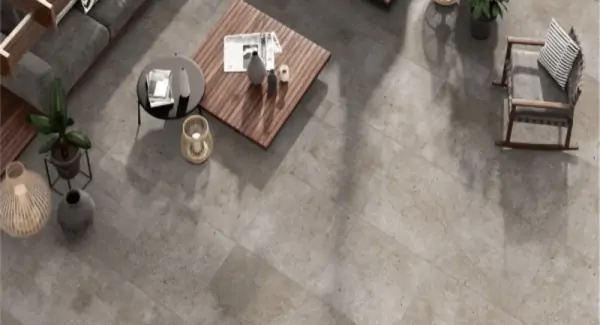
Large formet tiles, for example, are often chosen not just for how they look, but for what they remove. Fewer grout lines, fewer visual breaks. The space feels slightly more open, even if nothing else changes.
Some layouts mix materials, maybe stone-finish tiles with a bit of gravel or green in between. It breaks the uniformity just enough to make the terrace feel less rigid.
There are also plank-style tiles, especially in wood finishes. When laid in a linear pattern, they can gently pull the indoors outward. It’s not dramatic, but you notice it over time.
These kinds of terrace tile ideas don’t demand attention. They just make the space easier to be in.
3. Prioritizing Safety: Anti-Slip Terrace Tiles
This is one of those things people often realise a bit late. A terrace can feel completely fine until it rains.
Once the surface gets wet, even a slight smoothness can become a problem. That’s where anti-slip terrace tiles start to matter, not as a feature, but as something you rely on without thinking.
Tiles with an R11 or R12 rating usually offer a comfortable level of grip. Not too harsh, not too smooth. What’s changed recently is how that texture is built in.
With Lavish Ceramics, for example, the surface doesn’t feel aggressively rough. The grip is there, but it doesn’t interfere with the overall finish. That balance makes a difference, especially in spaces you use often.
4. Engineering for the Elements
Outdoor spaces don’t get a break from their environment. Sunlight, moisture, and temperature shifts are constant.
This is where weather-resistant outdoor tiles do their job.
Low water absorption is one of those technical aspects that sounds minor but has a long-term impact. Less water entering the tile means fewer chances of internal damage or issues beneath the surface.
Fading is another thing that creeps in slowly. Some tiles start to lose their depth of color after prolonged exposure to sunlight. Better-made surfaces tend to hold their tone longer, which helps the terrace age more evenly.
It’s not something you notice immediately. But after a few years, the difference becomes quite visible.
5. Advice you shouldn’t miss: Installation, Slope, and All That Matters
Even the best outdoor flooring tiles can fall short if the installation isn’t thought through properly. A few small decisions here can prevent a lot of inconvenience later.
A slight slope, around 1% to 2%, helps water drain instead of collecting in patches. It sounds basic, but it’s often overlooked.
Epoxy grout is another detail that doesn’t get much attention upfront. Compared to regular cement grout, it holds up better against moisture and doesn’t break down as easily.
And then there’s the question of colour. Surfaces in lighter tones don’t tend to trap as much heat, so if your terrace sits under direct sun for long hours, the difference is something you’ll actually feel underfoot.
A Final Checklist
Before making a decision, it helps to distill everything:
- Is the tile safe when wet?
- Will it withstand your climate?
- Does it require constant maintenance?
- Is it structurally suitable for your space?
- Will it still look composed after years of exposure?
Wrapping Up
A terrace doesn’t need to stand out to feel well done. In fact, the more successful ones are often the least demanding.
Choosing the right outdoor tiles for terrace areas, especially from thoughtfully developed ranges like those by Lavish Ceramics, is less about making a statement and more about avoiding problems you’d rather not deal with later.
At some point, the goal is simple. You want a space that holds up, feels comfortable, and doesn’t ask for too much in return. The rest tends to fall into place on its own.
Similar Articles
Leave a Reply