
Browse products by
Filter By Type
Filter By Finish
Filter By Look
Filter By Application


Filter By Type
Filter By Look
Filter By Application
Filter By Size
Blog
How Large Format Tiles Are Transforming International Architecture?
Jan 2026
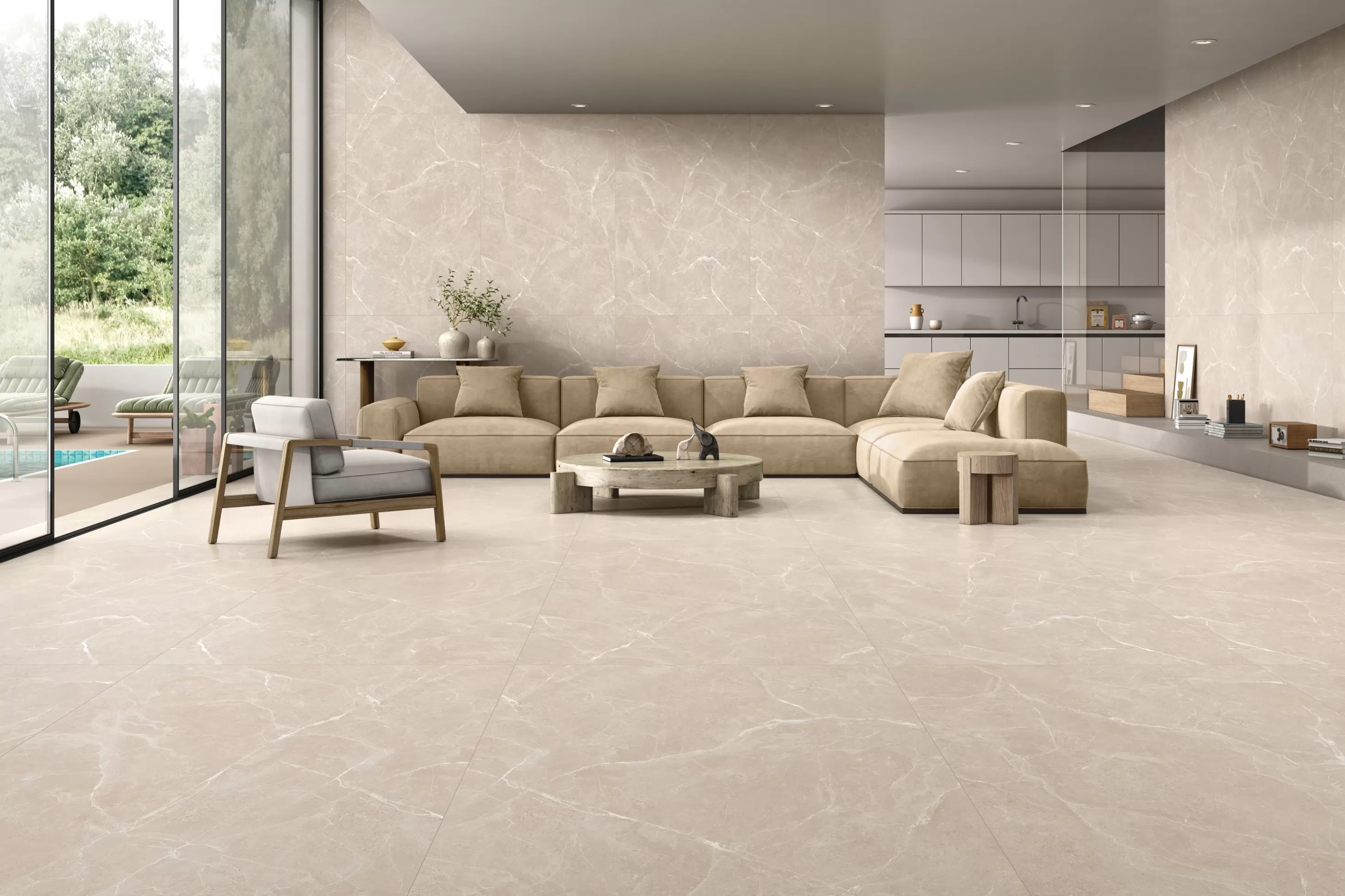
It happened gradually, as architects and designers began noticing how surfaces behave when visual interruptions are reduced.
As buildings became more open in layout and more restrained in material use, the role of surface finishes changed. Floors and walls were no longer expected to be decorative elements in a space. They were expected to support it.
Large format tiles fit into this shift naturally, which is why their adoption has been steady rather than trend-driven.
Let’s see how this shift is actually playing out.
First, What Are Large-Format Tiles?
Large-format tiles are ceramic or porcelain tiles that are significantly larger than traditional formats.
How large?
Well, industry guidelines typically classify any tile with one edge longer than 23 inches as large format. But in practice, it usually starts at around 600×1200 mm. There are many larger alternatives, 120×180 cm floor tiles, 1200×2400 mm slabs, and even bigger panels than these.
The key theme with these tiles is continuity. At this scale, tiles stop being treated as repetitive pieces; instead, they are installed with the intent of creating a continuous slab.
This is also why, in international projects, sourcing matters as much as specification.
Export-oriented manufacturers such as Lavish Ceramics tend to focus heavily on dimensional stability and batch consistency, because large-format tiles leave very little room for errors once installed.
Understanding How Large-Format Tiles Transform Modern-Day Aesthetics
As stated earlier, the most noticeable impact of large-format tiles is visual continuity. This is usually described in terms of grout lines, but the effect goes deeper than that.
Fewer Visual Breaks
When a surface is broken less often, the eye moves across it more easily. This makes spaces feel calmer and more organised, even when the layout itself is complex.
In open-plan interiors, this continuity helps connect different functional areas without relying on partitions. In smaller spaces, it prevents surfaces from feeling busy or cluttered.
This is why large-format floor tiles are frequently used in both compact apartments and expansive commercial interiors.
Surface Over Pattern
With large-format tiles, pattern repetition becomes less important. The focus moves to the surface as a whole.
Design approaches such as book matching are used selectively, usually on feature walls or focal areas. And the approach works best when tile collections are developed with scale in mind from the start.
Some lavish ceramics collections are designed specifically for large surfaces, where texture and veining are controlled to remain balanced even across formats like 120×180 cm tiles.
Large-Format Tiles Support Contemporary Architecture
Modern architecture relies heavily on restraint. Materials need to work together without drawing attention to themselves. Large-format tiles do this by creating a neutral base.
They work well alongside glass, steel, exposed concrete, and wood.
In residential settings, they help keep different areas visually consistent.
In commercial and hospitality projects, they allow large spaces to feel continuous rather than fragmented.
This is one reason large-format tiles are seen across different regions, from homes in Europe to hospitality projects in the Middle East and Asia.
Functional Advantages Of Large-Format Tiles In Real Projects
The growing use of large-format tiles is not driven by appearance alone. Practical performance plays an equally important role.
Durability and Maintenance
Most large-format tiles are made from porcelain, which is dense and resistant to moisture, stains, and abrasion.
On top of that, large-format tiled surfaces, as you know, have very few grout lines. That simply means fewer places for dirt to sit. Cleaning gets easier, and the surface stays hygienic over time.
These qualities make large-format tiles a good fit for high-traffic spaces like hotel lobbies, retail areas, airports, and offices, where easy maintenance matters as much as how the space looks.
Installation
Installing large tiles does take skill and good preparation. The surface needs to be flat, the adhesive has to be right, and alignment matters more. That said, once those boxes are checked, large tiles often make the overall installation simpler because fewer tiles cover more space.
In large commercial projects, this can help speed things up and make coordination between trades easier, even if the handling requirements are higher at the start.
Because of this, architects and contractors tend to work with exporters who know how large projects actually run. Brands like Lavish Ceramics are looked at not just for design, but for how consistently they can deliver across timelines and locations.
Multiple Applications
Today, large-format tiles are used beyond floors and walls, including facades, counters, bathroom surfaces, feature walls, and furniture cladding. Sticking to the same material across different uses helps maintain continuity throughout the project.
In cases like this, manufacturers that can maintain the same finish across different sizes and thicknesses, such as Lavish Ceramics, make this approach easier to execute without visual mismatches.
Manufacturing And Technological Developments
Whether large-format tiles work well or not depends a lot on the manufacturing technology behind them.
High-definition digital printing has made it possible to replicate natural materials with a high level of realism. This allows architects to achieve stone or marble-like surfaces without the unpredictability and maintenance challenges associated with natural materials.
Plus, with improvements in production, slabs can now be made thinner without losing performance. Thinner tiles weigh less and are easier to move and transport, which is especially useful for international projects.
You see this focus on production control more clearly with tile exporters working across global markets. Brands such as Lavish Ceramics prioritize process standardisation since once specified for a project, they can’t be treated as interchangeable commodities.
Wrapping Up
Large-format tiles are everywhere in architecture these days. Their use reflects a shift toward clearer, more continuous spaces with restrained materials.
With the right manufacturing, specification, and installation, these surfaces allow architects to deliver design that lasts, performs, and continues to inspire.
Because they’re not about the show; they’re used because they work, and that’s why you see them all over the world.
Similar Articles
Leave a Reply