
Browse products by
Filter By Type
Filter By Finish
Filter By Look
Filter By Application


Filter By Type
Filter By Look
Filter By Application
Filter By Size
Blog
What Are Terrazzo Tiles? A Modern Guide to Flooring’s Hottest Trend
May 2026
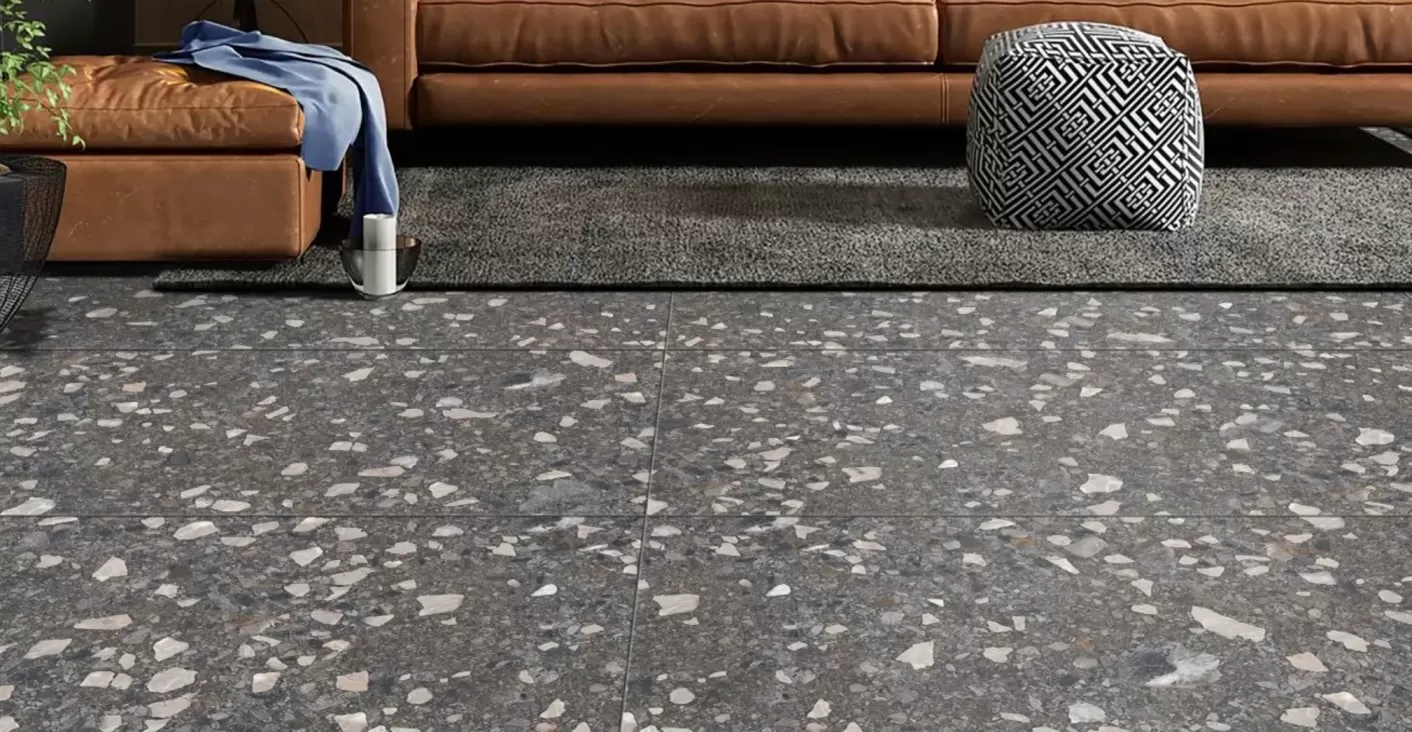
There are trends that arrive loudly and disappear quietly. And then there is terrazzo a material so old it predates the Renaissance, so beautiful it never really went away, and so perfectly suited to modern design sensibilities that its current revival feels less like a comeback and more like a correction.
In 2026, terrazzo tiles and terrazzo flooring are everywhere. Airport terminals, boutique hotels, high-end restaurants, contemporary homes, Instagram-worthy cafés terrazzo has made its way into every space that takes design seriously. And with good reason.
If you’ve been curious about terrazzo, what it is, why it’s having such a moment, and whether it’s right for your space this guide covers everything you need to know.
What Is Terrazzo?
Terrazzo is a composite flooring material made by embedding chips of marble, granite, quartz, glass, shell, or other aggregates into a binder traditionally cement, though modern versions use epoxy resin and then grinding and polishing the surface to a smooth, lustrous finish.
The word comes from the Italian terrazzo, meaning terrace. Its origins trace back to fifteenth-century Venice, where workers discovered that discarded marble offcuts from construction sites could be set into clay and ground smooth to create an inexpensive but remarkably beautiful floor for outdoor terraces. Over the centuries, the technique was refined, the binders improved, and terrazzo spread across Europe — into the grand public buildings of Italy, France, and Spain — before travelling to the rest of the world.
By the early twentieth century, terrazzo flooring was the material of choice for public institutions: airports, schools, hospitals, and government buildings favoured it for its durability, hygienic surface, and the sheer visual richness its speckled appearance delivered at scale. Walk through any Art Deco building built between 1920 and 1960 and you’re almost certainly walking on terrazzo.
Then came the vinyl era. Cheaper, faster, and easier to install, vinyl flooring displaced terrazzo in the latter half of the twentieth century. For a few decades, terrazzo became associated with the past rather than the present.
In the 2010s, design culture began rediscovering what it had lost. By 2026, terrazzo is firmly established as one of the defining materials of contemporary interior design.
What Are Terrazzo Tiles?
Traditional terrazzo flooring is poured in situ — mixed on-site, poured onto a subfloor, and ground smooth after curing. It’s a specialist installation process that requires significant skill and time.
Terrazzo tiles bring all the visual richness of traditional terrazzo in a format that is far easier to install, more consistent in quality, and available in a much wider range of colours and aggregate combinations than poured-in-place terrazzo can practically achieve.
At Lavish Ceramics, our terrazzo tiles are porcelain tiles that replicate the appearance of terrazzo through high-definition digital printing paired with surface texture delivering the speckled depth, tonal variation, and polished or matte finish of real terrazzo, with all the practical benefits of a fired porcelain tile: water resistance, extreme durability, low maintenance, and consistency across every tile in the batch.
Why Is Terrazzo Flooring So Popular Right Now?
Several forces have converged to make terrazzo the flooring material of the moment.
It photographs beautifully. In the age of visual social media, materials that create strong, distinctive images have a significant advantage. Terrazzo’s speckled surface especially in pastel or high-contrast colour combinations — is immediately recognisable and highly shareable. Hospitality spaces in particular have embraced terrazzo for this reason.
It connects to sustainability. The original terrazzo was built on the idea of using waste material — marble offcuts — rather than discarding it. This resonates strongly with contemporary consumers who are thinking more carefully about where their materials come from and what they’re made of.
It’s genuinely timeless. Unlike trend-driven materials that look dated within a decade, terrazzo has a proven track record of longevity. Choosing terrazzo flooring is choosing a material with five centuries of design history behind it. That’s a reassuring quality in an era of fast-moving aesthetics.
It works across every design style. Terrazzo sits comfortably in maximalist interiors filled with colour and pattern, and in minimalist spaces where it provides the only decorative note. It transitions between residential and commercial applications effortlessly. Very few materials are this versatile.
The colour range has expanded dramatically. Traditional terrazzo was limited by what aggregates were available locally. Modern terrazzo tiles are available in an almost limitless palette from pale blush with gold flecks to deep charcoal with white marble chips, from soft sage green with brass inclusions to warm terracotta with cream aggregate. There is a terrazzo tile for every interior palette.
Types of Terrazzo Tiles
Understanding the different types of terrazzo tiles helps you choose the right product for your space and budget.
Porcelain Terrazzo Tiles: The most practical and widely available option. Porcelain terrazzo tiles are fired at high temperature, making them extremely hard, dense, and water-resistant. They’re suitable for floors and walls in any room including bathrooms and kitchens, and for commercial applications. This is Lavish Ceramics’ primary terrazzo tile format.
Cement Terrazzo Tiles: Made from a cement base with real aggregate inclusions. These have a more handmade, artisanal quality than porcelain options and age beautifully over time. They’re more porous than porcelain and require sealing, making them better suited to lower-moisture environments.
Epoxy Terrazzo Tiles: A more modern format using an epoxy resin binder rather than cement. Epoxy terrazzo tiles are non-porous, highly resistant to staining, and available in the widest range of colours. They’re a popular choice for commercial and high-traffic applications.
Large-Format Terrazzo Slabs: For contemporary interiors that want the terrazzo look without visible tile joints, large-format terrazzo-effect porcelain slabs 800×1600mm and above create a near-seamless floor that feels like poured-in-place terrazzo while retaining all the practical benefits of a tile.
How to Use Terrazzo Tiles Room by Room?
Terrazzo Flooring in the Living Room
A terrazzo floor in the living room is a statement that works. Whether you choose a pale, speckled surface in cream and grey for a light, airy effect, or a bold terrazzo in deep green with marble chip inclusions for maximum drama, a terrazzo living room floor elevates the entire space. Large-format tiles minimise grout lines and create the most authentic terrazzo flooring experience.
Terrazzo Tiles in the Kitchen
Terrazzo tiles handle kitchen conditions beautifully. Their surface is resistant to moisture, staining, and heavy foot traffic. As a kitchen floor tile, terrazzo brings pattern and character to a space that is often dominated by practical considerations. As a kitchen splashback or island surround, a terrazzo tile in a complementary tone ties the whole room together.
Terrazzo Flooring in the Bathroom
The bathroom is where terrazzo tiles are most at home in 2026. A full terrazzo bathroom — floor and walls in the same tile — creates an immersive, spa-quality environment that is genuinely difficult to achieve with any other material. Choose a matte-finish terrazzo tile for the floor (better slip resistance) and a polished or satin version for the walls to create tonal variation within a cohesive palette.
Terrazzo Tiles in Commercial Spaces
Hotels, restaurants, cafés, retail stores, and office lobbies are the natural home of terrazzo flooring. Its durability terrazzo floors in public buildings routinely last 75 to 100 years with minimal maintenance makes it the most cost-effective premium flooring choice over the long term. Its visual impact makes every entry and reception area a design statement.
Terrazzo on Terraces and Outdoor Areas
Outdoor-rated porcelain terrazzo tiles bring the material’s warmth and pattern to balconies, terraces, and garden spaces. As with any outdoor tile, ensure the product has appropriate slip resistance and frost resistance ratings for your climate. Terrazzo tones in warm sand, terracotta, and soft grey work particularly beautifully in outdoor settings.
Caring for Terrazzo Tiles
One of terrazzo flooring’s great practical virtues is how easy it is to maintain. Porcelain terrazzo tiles require no sealing and no specialist products a regular sweep and a damp mop with a pH-neutral cleaner is all that’s needed to keep them looking pristine.
For cement terrazzo tiles, annual sealing is recommended to protect the surface from moisture penetration and staining. Avoid acidic cleaners (vinegar, lemon-based products) on any terrazzo surface, as acids can dull the aggregate and affect the binder over time.
Terrazzo Tiles from Lavish Ceramics
At Lavish Ceramics — Lavish Granito Pvt. Ltd., Morbi, Gujarat, we design and manufacture terrazzo tiles for residential, commercial, and export customers across India and more than 50 countries worldwide. Our terrazzo tile range is available in a wide selection of colours, aggregate patterns, sizes, and finishes from compact 600×600mm floor tiles to large-format 800×1600mm slabs.
- Download our tiles catalogue PDF for the full terrazzo range with product codes, sizes, and finishes.
- Request samples — see and feel the tile before you commit; samples dispatched on request.
- Trade and export enquiries welcome — we support architects, interior designers, contractors, and international distributors.
- Visit lavishceramics.com to explore the full terrazzo collection.
Terrazzo has lasted five centuries because it is genuinely beautiful, genuinely durable, and genuinely timeless. With Lavish Ceramics, it’s also genuinely accessible.
Similar Articles
Leave a Reply