
Browse products by
Filter By Type
Filter By Finish
Filter By Look
Filter By Application


Filter By Type
Filter By Look
Filter By Application
Filter By Size
Blog
Ultimate Stone Look Wall Tiles Design Ideas You Must Try in 2026
Mar 2026

Stone-inspired surfaces or stone-look wall tiles have been used in wall design for a long time, but the direction in 2026 feels slightly different. The change is not really about new patterns. It is more about how closely tiles can capture the depth, irregularity, and surface feel of actual stone.
Earlier, most options focused on visual similarity. Now, the expectation has shifted. Tiles are being developed to respond to light, texture, and even touch in a way that feels closer to natural materials.
Thus, stone look wall tiles designs are no longer seen only as a background layer. In many cases, they are used more deliberately, almost like part of the structure of the space itself.
The Shift Toward Tactile Realism
Across stone design wall tiles, one of the more noticeable changes is the move toward tactile realism. Smooth printed finishes are still available, but they are no longer the default choice.
Surfaces now tend to include some level of depth, whether through grain, light carving, or layered textures. Instead of looking completely uniform, they carry small variations that react differently under changing light.
Because of this, the same wall can look slightly different at different times of the day. Light creates natural shadows across the surface, which adds depth that flat finishes usually lack.
Chiseled and Structured Stone Surfaces
Within modern stone wall tiles, chiseled or split-face textures are showing up more often now. The idea is to replicate the uneven finish of hand-cut stone or stacked slate, rather than keeping the surface flat.
They are usually seen in vertical formats like 30×120 cm. This size works well on walls because it keeps the layout continuous without making the joints too noticeable.
Structured matt or carved finishes add variation, but not in an overwhelming way. When light hits the surface, some parts catch it while others fall into shadow, so the wall develops a bit of depth instead of looking flat.
These tiles that look like stone for wall applications are commonly used for:
- exterior elevations
- living room accent walls
- entry facades
Using the same texture across all walls can feel a bit too heavy. In most cases, it works better to keep it to one main surface and let the rest of the space stay simpler.
Travertine and the Return of Soft Mineral Surfaces
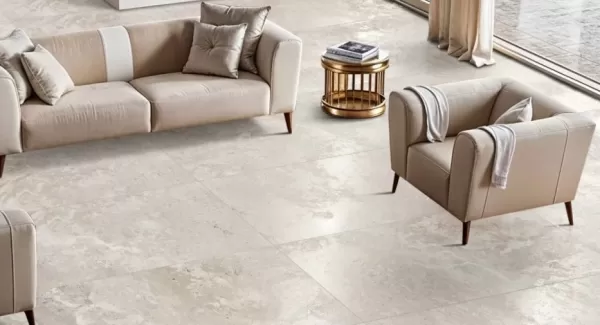
Alongside stronger textures, there is also a shift toward softer stone finishes, particularly those influenced by travertine and limestone. The emphasis here is not really on depth, but more on how the surface feels and how it handles light.
Satin or honed finishes tend to give a more muted effect. Instead of reflecting light directly, they soften it, which makes the surface feel less sharp.
These natural stone style tiles for wall applications are often used in spaces like bathrooms or bedrooms, where the overall requirement is to keep things calm and visually stable. They do not draw too much attention, but still add enough texture to avoid looking flat.
Full-height applications are quite common in this case. With fewer interruptions, the wall reads more like a continuous surface rather than a series of tiles.
Warmer tones such as sand, beige, or clay are also becoming more common. Compared to the earlier grey-heavy palettes, these feel slightly more grounded and less clinical.
Marble Surfaces with Controlled Boldness
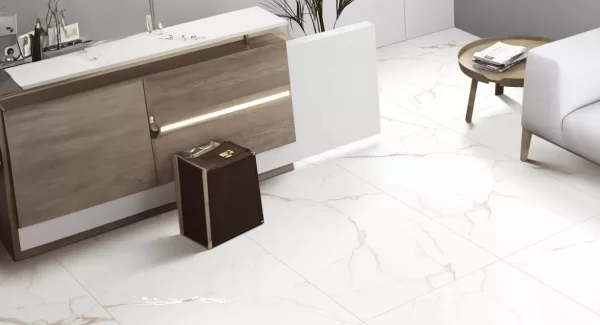
Marble-style wall tiles with a stone look are still widely used, but the approach has become more selective.
Instead of subtle grey veining, stronger patterns are being introduced. Deeper tones like green, amber, or burgundy are showing up more often, usually in larger formats.
These are often arranged as bookmatched surfaces, where two tiles mirror each other. This works best in specific areas:
- behind television units
- headboards
- entry feature walls
High gloss finishes are still used, though not across entire spaces. They tend to be limited to these focal points where reflection adds to the effect.
Sandstone and Earth-Driven Compositions
There is also a steady return of earth-based textures, especially sandstone and aged stone finishes.
These outside wall stone tile design ideas are often used to create a slightly weathered, grounded look. The surfaces are usually matte or lightly grainy, sometimes with slip-resistant properties.
Inside the home, they are commonly used in kitchens or transitional areas. Smaller formats are sometimes arranged in vertical stacks or structured layouts, which adds some geometry without relying too much on texture.
One detail that stands out here is grout. Instead of blending it in, contrasting grout is sometimes used to highlight the layout. It gives the wall a more defined, intentional structure.
Large Formats and Monolithic Applications
Large-format tiles are playing a bigger role now, especially in stone-look applications. Sizes like 80×160 cm or 120×120 cm reduce the number of joints, which changes how the wall reads visually.
With fewer joints, the surface appears more continuous. This works well when trying to create a monolithic effect, where the wall feels like a single material plane.
These formats are commonly used in:
- living rooms
- master bedrooms
- commercial interiors
Larger formats also depend heavily on calibration and surface consistency. In some cases, ranges like Lavish Ceramics’ GVT slabs are designed to maintain alignment across tiles, which helps reduce visible joints.
Application Across Interior and Exterior Spaces
Wall tiles with a stone look are now used across both interiors and exteriors, but the way they are applied does vary.For exterior walls, durability tends to matter more. Textured and matte finishes usually perform better here, especially in areas exposed to strong sunlight or dust.
Inside the home, usage is a bit more selective. Common applications include:
- feature walls
- bathrooms
- transitional zones
The difference mainly comes down to how the surface is handled. Exterior use leans more toward resistance and texture, while interior spaces focus more on tone and how the material blends with other finishes.
When comparing options, it helps to look at the surface finish rather than just the pattern. Tiles with structured or carved finishes, including those seen in collections from Lavish Ceramics, tend to work better for feature walls where some depth is needed.
Wrapping Up
The shift in stone look wall tiles in 2026 is not about making walls more decorative. It is more about making them feel considered.
Textures are more defined, finishes are more controlled, and applications are chosen with a bit more intent.
Instead of acting as a substitute for natural stone, these tiles are gradually forming their own category, with a design language that stands on its own.
Similar Articles
Leave a Reply