
Browse products by
Filter By Type
Filter By Finish
Filter By Look
Filter By Application


Filter By Type
Filter By Look
Filter By Application
Filter By Size
Blog
Top Tile Textures for Stylish and Functional Interiors
Mar 2026
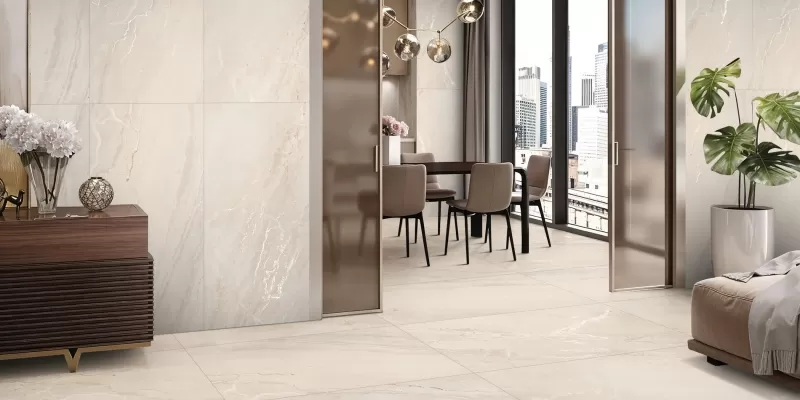
When interiors are designed thoughtfully, tile texture does more work than it is often credited for. It shapes how light behaves, how a surface feels underfoot, and how well it holds up to daily wear.
For a brand like Lavish Ceramics, this balance between tactile quality and durability sits at the centre of their approach to tile surface finishes.
Thus, from the Lavish Ceramics’ catalogue, here is a closer look at the textures shaping modern spaces, and how each one finds its place naturally within a home.
Satin Finish (Safe Choice for Most Living Spaces)
Satin is one of the easiest finishes to work with. It sits between matte and gloss, so it avoids both extremes.
The surface reflects a bit of light, but not enough to create glare. At the same time, it doesn’t go completely flat like matte. This balance makes it suitable for bedrooms and living rooms where lighting changes throughout the day.
From a practical point of view, satin does not highlight dust, footprints, or watermarks too aggressively. That’s why designers often treat it as a “default flooring” option for homes where ease of maintenance matters.
It also tends to blend well with different furniture styles, so you are not locked into one aesthetic. So, Satin in general has a kind of finish that feels consistent rather than attention-seeking.
High-Gloss Polished (Best Used Selectively)
High-gloss tiles fall on the reflective end of the matte vs glossy tile texture spectrum. They bounce light strongly, which can make smaller rooms feel larger.
This works well in entry areas or formal living rooms where you want a brighter, more finished look. But the same reflective quality also means it shows everything. Dust, smudges, scratches.
So while it looks premium, it is rarely used across an entire home. It’s more practical when limited to areas that don’t see constant movement.
In some cases, it is also paired with softer finishes nearby to balance out the overall look. That contrast often makes the glossy sections stand out without becoming overwhelming.
Matte and Soft-Touch (Low Maintenance, Low Distraction)
Matte finishes are straightforward. They absorb light, reduce glare, and keep the surface visually calm.
Soft-touch versions feel smoother but behave the same way visually. These are commonly used in modern homes where the idea is to keep the flooring neutral and unobtrusive.
They work especially well in larger areas because they don’t create visual breaks.
Also, from a maintenance standpoint, they hide daily wear better than glossy finishes, making them easier to live with over time.
If the goal is to keep the focus on furniture or layout rather than flooring, this finish usually supports that without interfering.
Sugar Finish (Practical for High-Use Areas)
Sugar-finish tiles lie somewhere between smooth and textured. The surface has a fine grain, which gives it a slight grip without making it rough.
This makes it particularly useful in kitchens and passage areas. These are spaces where spills happen, and movement is constant.
Another advantage is that it doesn’t show dust or minor dirt easily. So even with regular use, the floor tends to look relatively clean without frequent upkeep.
It also feels slightly more stable underfoot, which becomes noticeable in busy households where movement is continuous throughout the day.
Wood-Grain Embossed (For Warmth Without Risk)
Wood-look tiles with embossed surfaces try to replicate both the look and feel of real wood.
They are usually used in areas where a softer, warmer finish is needed, like dining spaces or study rooms. The texture adds variation, which breaks the monotony of flat surfaces.
The practical advantage is that, unlike real wood, these tiles handle moisture, scratches, and temperature changes without much issue. So they can be used more freely across different parts of a home.
They also age more evenly, without developing the kind of wear patterns that natural wood sometimes does.
Anti-Skid and Rock Finishes (Where Safety Comes First)
In certain areas, appearance becomes secondary. Bathrooms, terraces, and outdoor spaces need an anti-slip tile texture that provides grip.
The tiles are designed with a more pronounced surface texture to enhance slip resistance, particularly in wet conditions.
What’s improved is the design. Many of these now come with a natural stone tile texture or cement-like finish, so they don’t feel purely functional.
They blend better with the rest of the space while still doing their job. In outdoor areas, especially, this helps maintain a consistent look without compromising on safety.
Carved and 3D Surfaces (Focal Points)
Carved tiles fall under the 3D textured tiles design, where the surface is physically shaped rather than flat.
These are not meant for regular flooring. Instead, they are used as textured tiles for walls, especially in areas meant to stand out.
Because of the depth, light creates shadows across the surface, which adds visual interest. Designers usually limit these to feature sections so they don’t overwhelm the space.
When used carefully, they can define a space without the need for additional décor elements.
Rustic and Stone-Look (More Forgiving in Rough Conditions)
Tiles with a natural stone tile texture are less uniform and slightly irregular.
This makes them useful in areas that connect indoors and outdoors, or where surfaces are exposed to dust and wear. The variation helps hide imperfections instead of highlighting them.
They are also easier to maintain visually, because small marks blend into the texture rather than standing out.
As time passes, this makes the space feel more lived-in rather than worn out, which is often the intended effect.
What Actually Matters While Choosing?
If you simplify it, the choice comes down to use:
- Wet or outdoor areas, choose anti-skid finishes
- High movement spaces, choose sugar or matte
- Living and bedroom areas, choose satin or wood-grain
- Feature elements, choose glossy or 3D textures
In most cases, mixing finishes across a home works better than sticking to just one. It allows each space to function the way it needs to without forcing a single solution everywhere.
Wrapping Up
The difference between a good-looking space and a practical one usually comes down to surface decisions.
The right tile texture does not just look appropriate on day one. It continues to work without constant effort. And that’s what makes a space feel well-designed in the long run.
Similar Articles
Leave a Reply