
Browse products by
Filter By Type
Filter By Finish
Filter By Look
Filter By Application


Filter By Type
Filter By Look
Filter By Application
Filter By Size
Blog
Best Kitchen Floor Tiles Design for Modern & Functional Kitchens 2026
Mar 2026
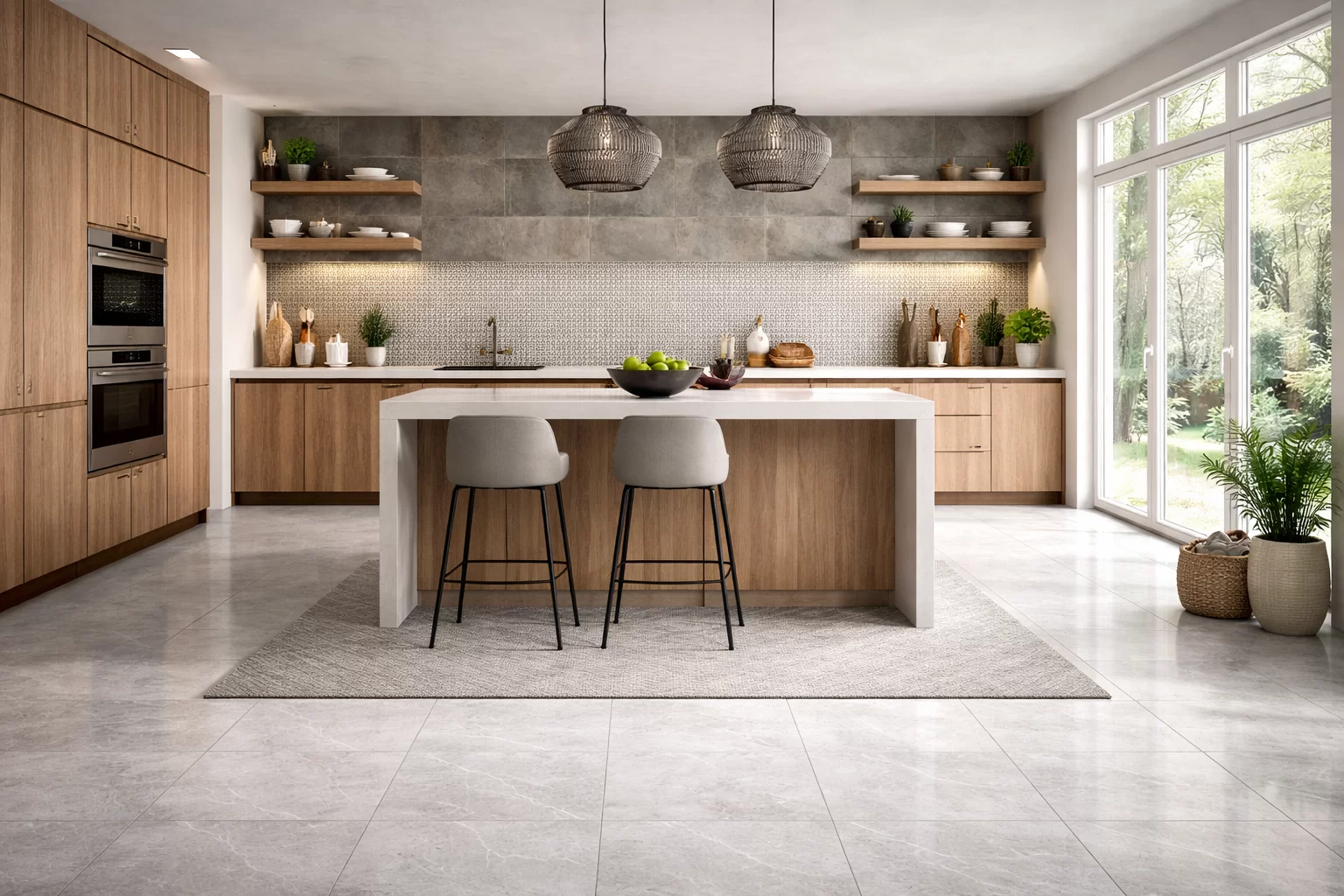
When selecting a kitchen floor tile design, the decision rarely rests on appearance alone.
Kitchens are not static spaces. They are used repeatedly, often hurriedly, and not always carefully. There is movement, moisture, oil splashes, and the occasional dropped utensil.
This is why most kitchen flooring ideas that look appealing initially do not always age well.
The real task is to find a surface that can absorb this everyday friction without visibly deteriorating, while still holding together visually with the rest of the space.
Within this context, exploring the material range offered by Lavish Ceramics can provide options that are both visually consistent and practically resilient.
Large-Format Neutrals and the Seamless Look
Among modern kitchen floor tiles, large-format glazed porcelain tiles in neutral tones remain one of the most reliable directions.
Greys, muted beiges, and softer charcoals tend to work across different cabinetry styles because they don’t compete for attention.
The real advantage, however, reveals itself gradually.
Kitchens tend to accumulate fine dust, oil residue, and light staining, and these often settle into grout lines first. By reducing the number of joints, larger tiles make the surface easier to maintain over time.
Formats like 60×120 cm help create a floor that feels visually continuous, almost uninterrupted. Within Lavish Ceramics, the Craft Series fits in this space. It is restrained in appearance, which allows other elements in the kitchen to take precedence without the floor feeling empty or unfinished.
Concrete-Inspired Surfaces
Concrete-look tiles represent a slightly sharper interpretation of minimalism within modern kitchen floor tiles. They remove visual softness and replace it with a flatter, more grounded surface.
This kind of flooring works particularly well in kitchens that already lean toward clean lines and minimal detailing. It supports the space rather than trying to elevate it.
There is also a practical side to this choice. Because these tiles avoid heavy veining or patterning, they tend to hide minor inconsistencies better than more decorative surfaces. As a result, they age in a quieter, less noticeable way.
A matte or satin finish is usually more suitable here. While polished surfaces may appear refined, they tend to demand more upkeep than most kitchens realistically allow.
Wood-Look Tiles for Warmth
There is always a pull toward wood because it introduces warmth and a certain softness that hard materials lack. Many kitchen flooring ideas gravitate toward this feeling, even when the environment itself is not ideal for natural wood.
This is where ceramic kitchen floor tiles or porcelain kitchen tiles that replicate wood become relevant. They offer the visual familiarity of timber but with a much more stable performance in kitchens.
And with time, this stability becomes important.
Moisture, heat, and repeated cleaning cycles can affect natural wood, but tile-based alternatives remain largely unaffected. They hold their form and require less attention.
Their plank format also allows for flexibility in kitchen tile patterns. While more intricate layouts can add character, simpler arrangements often feel more proportionate, especially in smaller kitchens where visual clutter builds quickly.
Marble-Look Tiles and Finish Selection
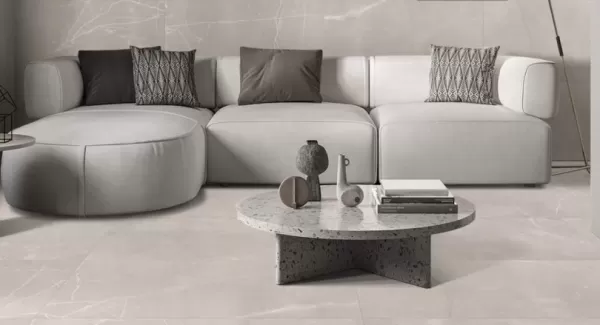
Marble-inspired surfaces continue to be among the more stylish kitchen floor tiles, largely because they brighten the space and reflect light effectively.
Using porcelain kitchen tiles, particularly in the form of glazed vitrified tiles, makes this approach more practical.
They resist staining and do not require the same level of care as natural marble.
However, the finish plays a larger role than it initially appears. Highly polished tiles tend to amplify every mark, from water spots to footprints. In a kitchen that sees daily use, this can become tiring to manage.
A softer finish, such as lappato or satin, tends to create a better balance. It reflects enough light to keep the space open and bright, but it does not exaggerate every imperfection.
Patterned and Geometric Floors
Patterned tiles have a strong visual presence, but their usefulness in kitchens is often more subtle. They help break up the surface in a way that makes minor wear less noticeable.
In terms of kitchen tile patterns, this means the floor does not immediately reveal crumbs, light stains, or uneven cleaning.
The effect is gradual but meaningful, especially in kitchens that are used frequently.
That said, restraint becomes important. Patterns that are too intricate or high in contrast can make the space feel visually heavy. Simpler geometric or tonal variations tend to integrate more naturally, allowing the floor to add character without overwhelming the room.
High-Durability Options
In kitchens with constant movement, durability becomes less of a feature and more of a requirement.
This is where Double Charge tiles, such as the Delta Series, fit in. They are designed to handle sustained use, with a thicker surface layer that resists wear over time.
They may not always fall into the most stylish kitchen floor tiles category, but they offer consistency. And in a kitchen, consistency often matters more than visual impact, especially when the space is used throughout the day.
Anti-Skid and Matte Finishes
Slip resistance tends to be overlooked during selection, but it directly affects how comfortable and safe a kitchen feels.
Many modern kitchen floor tiles now favour matte or slightly textured finishes because they provide better grip underfoot. This becomes particularly relevant near sinks or cooking areas, where spills are more likely.
What makes these finishes practical is that they do not significantly increase maintenance effort. They sit in the middle ground, offering safety without becoming difficult to clean.
Soluble Salt Tiles
Soluble Salt tiles remain part of the broader category of ceramic kitchen floor tiles, offering a more accessible option in terms of cost.
They perform adequately in terms of durability and maintenance, but they are generally more limited in design.
For that reason, they are often used in secondary kitchens or spaces where visual detailing is not the primary concern.
In more design-focused kitchens, other materials tend to offer better long-term satisfaction.
Wrapping Up
A well-functioning kitchen floor tile design is rarely the result of a single choice. It is usually the outcome of aligning material, finish, and format with how the kitchen is actually used.
With Lavish Ceramics, this means starting with the material, refining the finish based on usage, and then selecting the format that best fits the space.
It may not be the most obvious approach when exploring kitchen flooring ideas, but it tends to produce results that remain consistent long after the initial installation.
Similar Articles

Leave a Reply