
Browse products by
Filter By Type
Filter By Finish
Filter By Look
Filter By Application


Filter By Type
Filter By Look
Filter By Application
Filter By Size
Blog
How Tiles Make Spaces Feel Luxurious and Lavish?
Dec 2025

Floor Tiles, or tiles in general, are never an accident. Nobody casually ends up with hand-laid stone or glossy marble slabs or those perfectly imperfect artisanal tiles.
Someone chose them.
Someone cared about how they’d feel under bare feet, how they’d catch the light at different times of day, how they’d flex their interiors, without even mentioning it.
That’s where they built luxury! Covering an entire surface with beauty, piece by piece.
When you see tiles used well, it usually means extra decisions were made.
The room does what it’s supposed to do, but it also looks good doing it. Which is kind of the whole point of luxury anyway.
Hopefully, this gives you a rough idea of why tiles are so closely linked with luxury and lavish spaces.
Now, let’s go deeper and break it down properly.
Luxury Spaces are Designed with No Exit Plan!
One of the clearest differences between ordinary interiors and luxury spaces lies in how change is anticipated.
In ordinary spaces, everything is done with the idea that it can be changed later.
Walls get painted, knowing they will be repainted. Wallpaper goes up with the assumption that it can always be swapped out. Even the nicer finishes don’t feel permanent, no matter how expensive they look.But luxury interiors aren’t designed for quick change. They assume continuity.
Floor tiles make that long-term thinking unavoidable. After installation, there’s no easy rollback. That one choice ends up shaping everything else, from how furniture is arranged to how people move through the space and how the lighting is planned.This is why tiles have always appeared in palaces, heritage homes, premium hotels, and high-end residences, even though the styles vary widely. The common thread is not aesthetics. It is confidence. Confidence that the space does not need to reinvent itself frequently to remain relevant.
Tiles Control Scale in a Way Most Materials Can’t.
That sense of balance you notice in luxury spaces doesn’t happen by chance.
If you look closely, nothing feels rushed. Nothing feels visually crowded. There is space for the eye to move, pause, and rest. Tiles contribute to this more than most people consciously realise.
The size of a tile, the rhythm created by repetition, and the continuity across surfaces all influence how a space is perceived.
When done right, the space feels more settled, even though the dimensions haven’t changed.
And precisely, the goal isn’t visual exaggeration. It’s about getting the balance right, i.e., natural proportion, on which the luxury or lavishness of a space depends.
Tiles force those proportions to be considered carefully, because once they’re laid, poor scale choices stand out immediately.
Surface Quality is Where Luxury Becomes Sensory!
Luxury may not always announce itself visually, but it is deeply sensitive to how a space feels.
Light plays a major role here. Tiles react to it throughout the day, sometimes reflecting it, sometimes softening it, sometimes muting it. That shifts how the interior feels.
Low-quality surfaces tend to flatten light, making spaces feel dull or harsh depending on conditions. Well-crafted tiles behave differently.
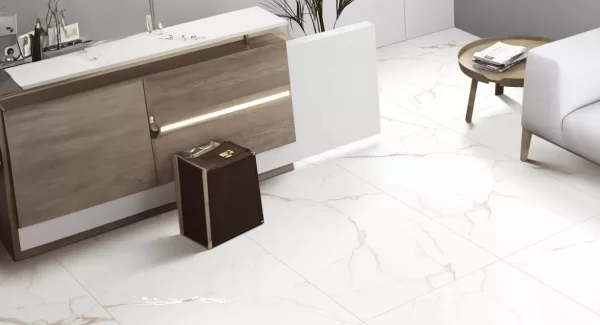
Matte finishes soften brightness without dimming the room. Polished tiles reflect light in a controlled way rather than creating glare. And textures give depth without calling attention to themselves.
These qualities aren’t random. They come from careful material choices and precise manufacturing, like what you see from reputed tile exporters such as Lavish Ceramics.
Less is more in luxury interiors!
There is a common assumption that luxury interiors are built by layering materials endlessly.
In practice, the opposite often holds true. Luxury spaces tend to simplify.
Fewer materials are used, but each one is expected to do more.
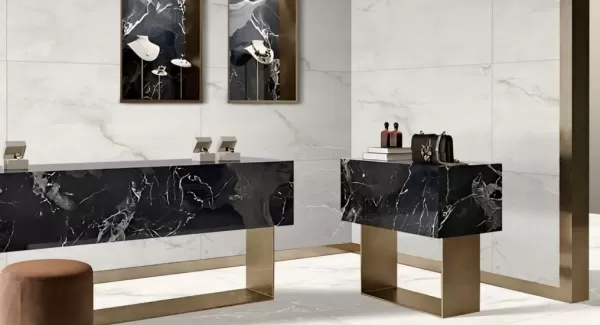
Tiles fit this vision because they can go from floor to wall, wet to dry, without breaking the look of the room.
And actually, keeping things consistent matters a lot. If materials keep changing, the space can start to feel all over the place. But when one material runs across different zones, the room feels put together.
That sense of cohesion brings calm, and calm is one of the clearest signs of luxury.
Tiles Carry Identity Without Forcing it!
Luxury spaces tend to have a defined style, yet they keep it understated. And it’s the tiles which do a lot to set that tone.
For instance, stone-inspired tile suggests weight and grounding.
Neutral surfaces allow architecture and light to take precedence.
Textured finishes hint at craftsmanship without demanding attention.
Because what matters in lavish spaces is restraint. And thankfully, tiles do not impose identity. They support it. They let designers carry a narrative across rooms without getting repetitive.
This balance is hard to pull off with finishes or surfaces that change character too easily.
Where does Lavish Ceramics Fit Into this Conversation?
In this context, a brand mention only makes sense when it aligns with the philosophy.
And in this case, it really does!
With tiles built for precision, durability, and international quality standards, Lavish Ceramics slots into projects where luxury is measured in restraint, longevity, and grandeur, not in following whatever’s trendy.
Wrapping Up
True lavishness reveals itself slowly. It shows in little things. For example, how the floor feels first thing in the day, how surfaces hold up without getting messy, and how they age gracefully. Think about the Taj for a second. Hasn’t this architectural marvel been there for so long, while still being luxurious and even ethereal?
All because it was built to last. Tiles work the same way. When you pick the right ones, from the right tile exporters, they set the tone, carry a space, and stay looking and feeling good for years, without needing to be replaced or updated all the time.
Similar Articles
Leave a Reply