
Browse products by
Filter By Type
Filter By Finish
Filter By Look
Filter By Application


Filter By Type
Filter By Look
Filter By Application
Filter By Size
Blog
Why Architects Prefer Large Format Tiles for Premium Projects?
Dec 2025
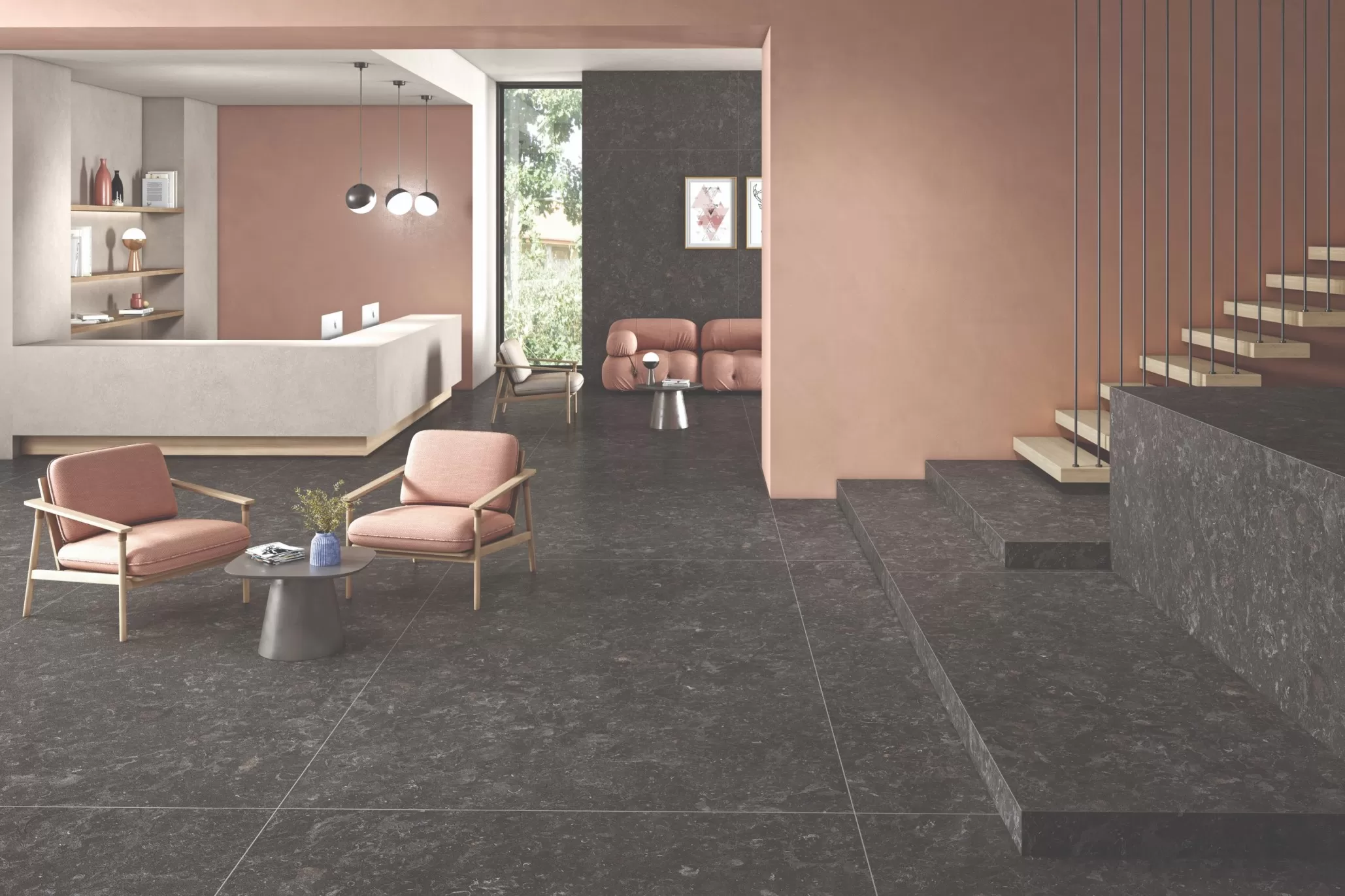
Every architect knows this moment. You are standing inside a half-built commercial space. The structure is done, the volume is impressive, and the ambition is obvious.
Though there’s still a crucial design decision to make, i.e., what will go on the floors?
One needs to pick floor tiles that look premium on day one and still make sense years later, after endless footsteps, rolling trolleys, regular cleaning, and more than a few critical design reviews along the way.
And more often than not, architects opt for large-format tiles, particularly 1200 × 1800 mm slabs. Let’s know why!
Seamless Aesthetics
Commercial spaces demand materials that match their spatial scale.
If you use smaller tiles in these areas, the floor plane gets fragmented. The eye keeps stopping. The space starts to feel busy, even when the design is restrained.
Therefore, architects tend to avoid this risk and mostly choose large-format tiles for such areas. With fewer visual interruptions, these tiles allow the floor to read as a continuous surface, reinforcing:
- Spatial calm
- Visual hierarchy
- A sense of deliberate luxury
Fewer Joints, Fewer Problems
You can’t really get rid of grout lines, but if there’s a way to minimize them, it’s almost always a smarter choice for a commercial space. And that’s a decision architects happily make.
Because, agree or not, grout lines are often the weakest link in commercial flooring. They collect dirt, discolor faster, and demand disproportionate maintenance attention.
All of this trouble can be avoided with Large-format tiles. Since they are broad enough, they significantly reduce joint density, improving long-term appearance and maintenance efficiency.
Moreover, architects trust brands like Lavish Ceramics that curate precision-manufactured tiles for consistent joint widths, which becomes especially valuable in large, publicly visible spaces.
Scale Matters More Than Samples (And Architects Know This Too Well)
Most of you might not be aware of what goes on behind the designing of a structure, unless, of course, some of you are architects.
To put it simply, what looks elegant on a 2×2 sample board can feel painfully inadequate when stretched across a 60-metre-long mall corridor. Because commercial architecture magnifies every design decision.
Well, again, Large-format tiles respect the scale of commercial spaces, aligning seamlessly with structural grids, accommodating large column spans, and maintaining long, uninterrupted sightlines.
This is precisely why these tiles are a 10/10 from an architect’s POV.
Durability Is About Load Distribution, Not Just Thickness
There is a persistent myth that thicker tiles automatically mean better performance. In reality, durability in commercial flooring depends more on how stress travels across the surface.
And that very problem only adds to the utility of large-format tiles, because no tile size outperforms 1200 × 1800 mm floor tiles when it comes to distributing load evenly across the floor surface. Thanks to their generous size, of course. This makes them especially suitable for high-stress zones such as main entrances, anchor store areas, escalator landings, and lobby spaces.
Moreover, pairing large-format tiles with proper substrate preparation and installation systems makes these tiles super reliable. And thus, reduce localized stress and edge damage.
Well, to ensure these tiles truly deliver on all of this, Lavish Ceramics develops its large-format tiles with these performance conditions in mind, focusing on consistency and structural behavior rather than surface appearance alone.
No doubt, architects continue to trust them for demanding commercial environments.
Maintenance Logic That Actually Works
Architects do care about post-installation performance. They may not be on site every day after handover, but their reputation, references, and repeat work depend on how the space ages.
This gives them yet another reason to opt for large-format tiles. These tiles have a predictable maintenance routine and are comparatively easier to maintain in premium commercial spaces than their smaller counterparts.
- Daily dry dusting prevents abrasive particles from dulling the surface. Neutral pH cleaners preserve finishes without chemical stress.
- Periodic deep cleaning and timely grout care keep floors looking intentional rather than “managed.”
- Sealing, where required, further extends the life cycle.
The result is not just a good-looking floor, but a surface that ages gracefully, which is perhaps the most underrated design outcome.
Quality that Architects Trust
Now that you’ve likely come across enough reasons to understand the why behind choosing large-format tiles for premium projects, it’s worth turning your attention to the tile quality that truly matters when making that selection.
Well, as a matter of fact, in such projects, materials are rarely chosen on appearance alone. Architects look for consistency, predictability, and performance they can rely on, long after the drawings are approved and the site is handed over.
This is why many architects trust Lavish Ceramics for large-format tiles in premium commercial spaces. The brand delivers on durability, strength, and structural integrity, while still giving architects plenty of creative freedom. The 1200 × 1800 mm collection comes in multiple textures, finishes, and designs, allowing design intent to shine without compromise.
With Lavish Ceramics, architects don’t have to sacrifice style for practicality, as they get the best of both worlds.
Wrapping Up
So, why do architects keep coming back to large-format tiles for premium projects? By now, the answer feels less like a guess and more like a quiet understanding that comes from experience.
At the heart of it, the choice is driven by things that truly matter in high-end spaces.
- How well a surface performs under constant use.
- How easy it is to maintain day after day.
- And how the space looks and feels once the initial excitement settles.
In premium commercial environments, large-format tiles handle all of this with ease, which is why architects trust them for projects where standards are high and expectations even higher.
Similar Articles


Leave a Reply